
HITRUST Certification: An Executive Guide to Risk, Trust, and Healthcare Compliance at Scale

In 2026, a "check-the-box" approach to HIPAA is no longer a safety net - it's a liability. For mid-sized medical practices and high-growth healthcare startups, the margin for error has vanished. With the average cost of a healthcare data breach now reaching $10.22 million, security is no longer just an IT line item; it is a core pillar of your business's valuation and viability.
While HIPAA remains the legal baseline, its inherent vagueness can leave executives with a false sense of security - one that crumbles under the pressure of an audit or a breach. HITRUST Certification exists for leaders who recognize that trust is their most valuable currency. It moves your organization beyond "addressable" compliance into a state of validated, measurable resilience. This guide translates the technical complexities of the HITRUST framework into the strategic insights you need to protect your patients, your reputation, and your bottom line.
22% of all ransomware attacks in 2026 targeted healthcare companies* *HIPAA journal
What is HIPAA?
HIPAA (Health Insurance Portability and Accountability Act) is a federal law that outlines security and privacy standards for protecting patient information. HIPAA applies to all healthcare providers, health plans, and clearinghouses that electronically store or transmit health information. HIPAA covers the confidentiality, integrity, and availability of electronic protected health information (ePHI) and requires covered entities to implement physical, technical, and administrative safeguards to protect ePHI.

What is HITRUST
HITRUST (Health Information Trust Alliance) is a privately owned organization that developed the Common Security Framework (CSF) to address security and regulatory compliance for organizations that store or process sensitive information. The HITRUST CSF provides a comprehensive and flexible approach to regulatory compliance and risk management, covering a broad range of industry regulations, including HIPAA, PCI DSS, and ISO. HITRUST is not a law but a framework that healthcare organizations can use to meet the legal requirements of HIPAA and other regulations.
HITRUST simplifies compliance by aligning multiple frameworks into one, offering certification and detailed assessments that demonstrate an organization's security posture. This makes it a valuable tool for organizations looking to prove their adherence to industry standards through independent evaluation
HITRUST vs. HIPAA: Why the Distinction Matters to Your Board
A common misconception among healthcare executives is that "HIPAA compliant" and "HITRUST certified" mean the same thing. They do not — and confusing the two is a costly mistake.
HIPAA is a Law. It is a federal mandate with no official certification pathway. You are either in compliance or you are not — and you typically find out which only during an Office for Civil Rights (OCR) audit or in the aftermath of a breach.
HITRUST is the Proof. HITRUST provides third-party validated certification. It is the gold standard that signals to your patients, your board, and your insurance carriers that a neutral, qualified assessor has independently verified your controls.
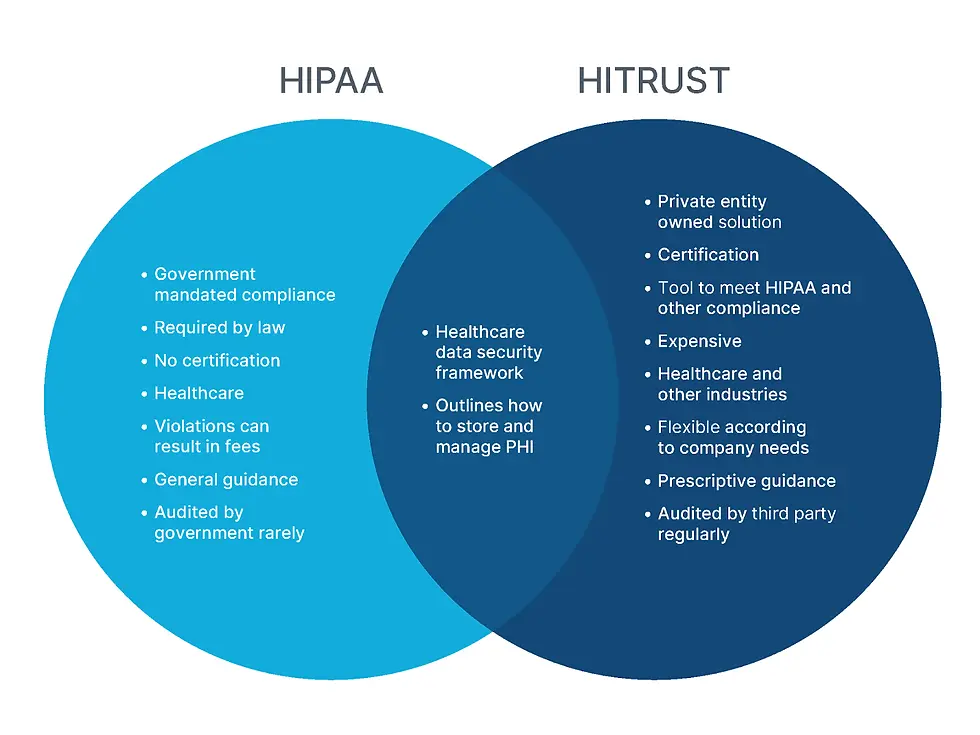
In 2026, the regulatory environment has shifted meaningfully. When the OCR investigates a breach, it increasingly looks for evidence that the organization followed a recognized security framework - not just that it intended to comply.
This is where HITRUST delivers what HIPAA cannot: prescriptive, auditable guidance. HIPAA might require "encryption," but HITRUST specifies exactly what type, where to apply it, and how to document it for an auditor. For small clinics and growing healthcare organizations alike, that specificity isn't bureaucratic overhead - it's a roadmap.
What Is HITRUST Certification? Understanding the CSF v11.7 Framework
To understand HITRUST certification, start with its foundation: the HITRUST Common Security Framework (CSF). Now in version 11.7, the CSF is a comprehensive framework that harmonizes multiple compliance standards - including HIPAA, NIST, ISO, and PCI - into a single, actionable roadmap. Rather than treating each regulation as a separate obligation, it unifies them into one structured program.
The "Assess Once, Report Many" Philosophy
The core efficiency advantage of HITRUST lies in this principle. Instead of undergoing separate audits for HIPAA, SOC 2, and NIST, a single HITRUST assessment maps to all of them simultaneously. For a startup scaling rapidly or a clinic managing third-party vendor risk, this eliminates audit fatigue and meaningfully reduces the long-term cost of compliance.
The Threat-Adaptive Model
Version 11.x introduces a design principle that sets HITRUST apart from static frameworks: threat adaptability. Requirements are updated quarterly to reflect the evolving threat landscape - including Shadow AI and deepfake-driven phishing, two attack vectors that saw a reported 100% increase in healthcare targeting over the past 12 months. In a sector where yesterday's controls may not stop tomorrow's breach, this matters.
The Strategic Business Case: Why Small Practices and Startups Need HITRUST
For years, HITRUST was viewed as a large health system requirement - something for enterprise compliance teams, not growing clinics or early-stage startups. That perception shifted decisively in 2024 and 2025, as major payers and hospital systems began mandating HITRUST certification for all business associates and vendors as a condition of maintaining contracts.
1. Protecting Exit Value and Investment
If your startup is targeting a Series B or positioning for acquisition, expect rigorous cybersecurity due diligence. Investors in 2026 are acutely aware of compliance debt. An organization that holds a HITRUST i1 or r2 certification is perceived as a lower-risk asset - one where the buyer isn't inheriting undisclosed exposure. That perception translates directly into valuation: certified companies enter negotiations from a position of documented trust rather than assumption.
2. The Cost of Non-Compliance and the Trust Tax
The financial penalties are well-documented, but the more insidious cost is reputational. According to The HIPAA Journal's 2026 Cybersecurity Analysis, healthcare is now the most-targeted industry globally, accounting for 22% of all ransomware attacks - more than any other sector.
For a small clinic, the reputational damage from a breach is often permanent. Patients today actively check the OCR breach portal - widely known as the "Wall of Shame." HITRUST certification signals an elite, independently verified commitment to privacy, making it as much a trust-building asset as a compliance instrument.
3. Cyber Insurance Eligibility
The cyber insurance market has hardened considerably. In 2026, insurers are increasingly denying coverage or imposing steep premium increases on healthcare entities that cannot demonstrate adherence to a recognized security framework. HITRUST certification can unlock better coverage terms and meaningfully lower premiums - often offsetting a significant portion of the certification investment itself.
How to Navigate the Three HITRUST Certification Levels
One size does not fit all. HITRUST offers three distinct pathways tailored to your organization's risk profile and size.
HITRUST Certification Tiers
Certification Level | Strategic Focus | RQMTS | Best For.. | Duration |
|---|---|---|---|---|
e1 (Essentials) | Foundational cybersecurity hygiene and basic threat mitigation. | 44 static controls | Small medical practices or startups that need rapid, entry-level validation. | 1 Year |
i1 (Implemented) | Industry best practices and "threat-informed" security. | ~219 static controls | Mid-sized clinics/startups handling moderate ePHI volume and seeking moderate assurance. | 1 Year (Rapid recertification available) |
r2 (Risk-Based) | The "Gold Standard" of comprehensive, risk-based security. | Tailored (Avg. 385-800+ controls) | Large enterprises or startups seeking federal contracts, global scale, or high-risk assurance. | 2 Years (Interim review required at Year 1) |
Breaking Down the HITRUST Certification Cost
Executives often pause at the price tag - understandably so. But HITRUST certification cost is best understood not as an expense, but as a risk mitigation investment. The total investment typically falls into three categories:
HITRUST Fees. This includes the mandatory MyCSF platform subscription and report credits. Depending on the certification level - e1, i1, or r2 - expect to invest between $6,000 and $30,000 directly with HITRUST.
External Assessor Fees. HITRUST requires an authorized external assessor to validate your work. For a small clinic or early-stage health tech vendor pursuing an e1 assessment, fees typically range from $25,000 to $50,000. For a growing software company or startup pursuing r2 certification - where the scope often includes cloud infrastructure, APIs, and third-party integrations — assessor fees can exceed $100,000.
Internal Effort. This is the cost most organizations underestimate. Your IT, engineering, and compliance staff will invest hundreds of hours in evidence gathering, documentation, and remediation. For healthcare software vendors, this burden is compounded by the need to map controls across development environments, CI/CD pipelines, and customer data boundaries. Engaging an experienced partner to act as a virtual CISO - managing the process end to end - can dramatically reduce this burden and compress the timeline.
The Strategic Perspective. The average cost of a breach for a small healthcare provider now exceeds $7 million - and for software vendors handling data across multiple covered entities, the exposure is often higher. A $75,000 investment in HITRUST certification represents roughly 1% of that risk. Few mitigation strategies in any industry offer that ratio. The question is not whether you can afford HITRUST - it is whether you can afford to forgo it.
Steps to Achieve HITRUST Certification: A Practical Roadmap for Small Clinics
Whether you are an IT Director at a small clinic or a CTO at a healthcare software company, the path to HITRUST certification begins well before a formal assessment. Start with a Gap Assessment to establish your baseline - do not attempt to jump straight into a validated assessment.
1. Define Your Scope. For clinics, the scoping decision often comes down to the entire practice versus the EHR environment. For software vendors, the question is more complex: which products, environments, and data flows are in scope? A SaaS platform handling PHI across multiple clients will have a materially different scope than a single-tenant clinical tool. Scope definition is one of the highest-leverage decisions in the process — a narrower, well-defined scope reduces applicable controls, lowers assessor fees, and shortens the timeline without compromising certification value.
2. Select the Right Certification Level. For most clinics and early-stage vendors, starting with an e1 or i1 is the pragmatic choice. These levels are designed to be achievable without an enterprise-scale compliance program. As your organization grows - or as enterprise customers begin requiring r2 as a contracting condition - you can progress accordingly.
3. Remediate Identified Gaps. Use your gap assessment findings to build a prioritized remediation roadmap. For clinics, common focus areas include encryption configuration, policy documentation, and multi-factor authentication. For software vendors, remediation frequently extends into secure SDLC practices, access control architecture, and vulnerability management programs. Address gaps systematically - not all at once.
4. Build Your Operational History. This step surprises many first-time applicants: HITRUST requires 90 days of documented operational history. It is not enough to have controls in place - you must demonstrate they have been functioning consistently. For vendors operating in agile or continuous deployment environments, this means embedding compliance evidence collection into your standard engineering workflows well ahead of the assessment window.
Navigate the Path to HITRUST
Achieving HITRUST certification is a significant milestone, but you don’t have to navigate the complexity alone. At Plexteq, we believe the best compliance strategies start with a deep understanding of your unique operational goals. Our approach is built on a Discovery and Design model: we start by identifying your specific risk gaps and then engineer a custom roadmap that aligns your security needs with your budget.
Whether you are a startup preparing for your first audit or a growing clinic looking to simplify your compliance overhead, our team of experts provides the hands-on guidance and vCISO leadership needed to turn a daunting requirement into a scalable business advantage.
Learn more about how our specialized healthcare IT teams support your mission through secure, high-performance technology.
Frequently Asked Questions
What is the primary difference between HIPAA and HITRUST Certification?
HIPAA is a federal regulation (law) that sets the standard for protecting patient data but offers no formal certification. HITRUST is a private, certifiable framework that incorporates HIPAA’s requirements along with other global standards. While HIPAA tells you what to do, HITRUST provides the prescriptive how and offers a third-party validated seal of approval.
How much does HITRUST Certification cost for a small medical practice?
For a small practice pursuing the e1 (Essentials) level, the total direct cost (platform fees + assessor fees) generally ranges from $35,000 to $60,000. This does not include internal staff time. However, this cost is often offset by lower insurance premiums and the avoidance of "business associate" audit costs from larger partners.
What are the three HITRUST Certification levels?
The three levels are e1 (Essentials), which focuses on basic hygiene with 44 controls; i1 (Implemented), a moderate-level certification focused on best practices with ~219 controls; and r2 (Risk-Based), the most rigorous, 2-year certification tailored to high-risk organizations.
How long does it take to become HITRUST certified?
For a first-time certification, a small-to-mid-sized organization should plan for 6 to 12 months. This includes a gap analysis phase (2-3 months), remediation of identified issues (3-4 months), and the final validated assessment by an external auditor (2-3 months).
Is HITRUST mandatory for small medical clinics?
While not a legal mandate like HIPAA, HITRUST is becoming a "de facto" requirement. Many large insurance payers, hospital networks, and health tech platforms now require their vendors and partners to be HITRUST certified to ensure the integrity of the broader healthcare supply chain.
What are the specific HITRUST Certification requirements for a startup?
Requirements vary based on the level chosen, but they generally involve demonstrating maturity in 19 different domains, including Access Control, Endpoint Protection, Risk Management, and Third-Party Security. Startups must provide documented policies, procedures, and, crucially, evidence that these controls have been active for at least 90 days.
Can we achieve efficient HIPAA compliance without HITRUST?
You can technically be HIPAA compliant without HITRUST, but it is difficult to prove it efficiently. Without a framework like HITRUST, you will spend significantly more time responding to individual security questionnaires from every partner and vendor you work with. HITRUST provides a "report once" solution that satisfies almost all stakeholders.
What happens if we fail our HITRUST assessment?
HITRUST is a maturity-based framework. If you do not meet the scoring threshold for full certification, you may be issued a "Validated Assessment Report" which identifies your gaps. You can then work with your vCISO to remediate these specific areas and resubmit for certification.
How does HITRUST help with cyber insurance?
In 2026, many cyber insurance carriers require a formal security framework for eligibility. HITRUST certification serves as definitive evidence of your risk management maturity, which can lead to higher coverage limits, lower deductibles, and reduced annual premiums.
Does HITRUST cover other regulations like GDPR or SOC 2?
Yes. The HITRUST CSF is "harmonized," meaning it maps directly to GDPR, SOC 2, NIST 800-53, and even PCI DSS. When you achieve HITRUST certification, you can often generate "bridging reports" that satisfy the requirements of these other frameworks with minimal additional effort.


