
Healthcare IT Outsourcing in 2026: Stop Moving Admin Work, Start Removing It

Table of Contents
Physicians often report spending much of their day away from patients. A study in the Annals of Internal Medicine found doctors spend 49% of office hours on EHR and desk work, and only 27% with patients. Toasks like prior authorizations, eligibility checks, coding queries, and managing a constant flow of messages now take more time than direct patient care.
Healthcare leaders recognize this challenge. In Deloitte’s 2025 executive outlook, over 70% of C-suite respondents identified process efficiency as a top priority. In response, the outsourcing market has expanded, with healthcare BPO valued at over $400 billion.
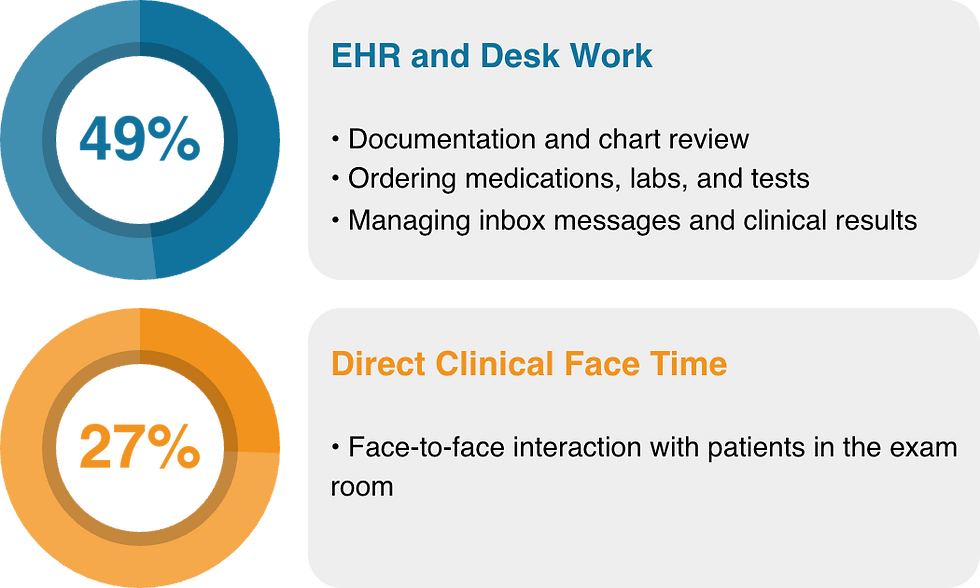
49% of physicians' office time goes to EHR and desk work 27% goes to patients 240-400 hours per nurse per year could be freed by existing technology >70% of health system executives rank process efficiency a top priority 78% of providers already use AI in revenue cycle management 190 million records exposed in a single vendor breach (Change Healthcare, 2024)
A big chunk of those 49% comes from software: unintegrated systems, workflows relying on manual entry, tools designed for billing rather than user needs, and suboptimal UX. Between 2020 and 2026, healthcare organizations began outsourcing not only the work but also the engineering needed to remove it.
This article shows how healthcare IT outsourcing evolved over the past six years from the Plexteq experience, notes where software delivers the greatest efficiency gains, and outlines factors that highly likely will influence partner decisions through 2030.
What healthcare leaders are focusing on
In Deloitte’s survey of health system C-suites, more than 70% said improving process efficiency and productivity is a priority. Other findings from the same survey:
About 60% said they need to invest in core technologies such as EMR and ERP systems.
78% named stronger cybersecurity as a priority.
Workforce pressures add to the challenge. The WHO projects a shortfall of 10 million health workers by 2030. When hiring cannot solve administrative backlogs, organizations must turn to engineering or delegation.
Where the money goes
Two distinct markets have developed in response to the administrative burden, and it is important to differentiate between them:
Market | 2025 value | Outlook | Source |
|---|---|---|---|
Healthcare BPO (people-led operations: billing, claims, coding, contact centers) | $421.2B | $735.1B by 2031 (9.8% CAGR) | MarketsandMarkets, July 2026 |
Healthcare IT outsourcing (software, infrastructure, managed IT) | $58-64B | ~$100B+ by early 2030s | IMARC; Research and Markets |
The key issue is the disparity: organizations spend about seven times more on personnel to process administrative work than on technology partners and solutions to reduce it.
Where the market is heading
The Business Process Outsourcing (BPO) market is shifting toward software solutions, and AI-enabled BPO is likely the fastest-growing segment through the next five years, driven by vendors incorporating generative AI, machine learning, and NLP into workflows. Analysts describe this as a shift from traditional labor-based outsourcing to automation, AI-enabled workflows, and platform-based models.
HFS reports that 78% of providers use AI in revenue cycle management. A Q2 2026 PitchBook analysis warns that agentic AI could reduce the RCM revenue pool to 78% of 2026 levels by 2030.
The takeaway: the industry has spent the last six years buying more hands to do administrative work. The bigger opportunity is to buy less of that work in the first place. This is the shift the rest of the article traces.
Two ways to outsource the burden: people vs. systems
When a healthcare organization can no longer manage additional administrative work internally, it has two options: delegate the work to an external team or engage an external team to modify systems to reduce or eliminate the workload. Both are forms of outsourcing but address different challenges with distinct cost implications.
Outsourcing the work (BPO) | Outsourcing the engineering | |
What changes | Who does the task | Whether the task exists |
Time to impact | Weeks | Months |
Cost curve | Linear with volume | Front-loaded, then declining |
Effect on internal staff | Workload shifts to vendor; exceptions return | Workload falls for everyone |
Effect on clinicians | Indirect | Direct (fewer clicks, less inbox, less re-entry) |
Best fit | Variable, judgment-heavy, low-standardization work | High-volume, rules-based, repetitive work |
Main risk | Rising cost, quality drift, vendor dependency | Upfront spend, adoption, AI governance |
What you own at the end | A contract | An asset |
The key question for buyers is no longer whether to choose BPO or IT but who owns the automation and who benefits from the resulting savings. If a BPO vendor automates processes within its own platform, the vendor retains the productivity gains and margin. If you implement automation within your own systems with an engineering partner, your organization captures the savings.
How we got here: 2020-2026
Healthcare IT outsourcing has changed significantly since the pandemic began. This transformation occurred in four phases, each causing new challenges and reshaping expectations for outsourcing partners.

Period | What happened | What it did to the admin burden | How outsourcing responded |
|---|---|---|---|
2020-2021: Emergency driven market | Within weeks of the first lockdowns, providers had to stand up telehealth, remote access for staff and new patient communication channels. Cloud migrations planned for years were compressed into months. IT teams that had been sized for steady-state maintenance were suddenly running transformation projects. | Telehealth removed the waiting room but not the paperwork. Every virtual visit still needed scheduling, eligibility checks, documentation and billing, often in systems bolted together in a hurry. Patient portals and messaging opened a new channel, and inbox volume grew with it. | Outsourcing in this phase was about capacity and speed: extra development hands, rapid integrations, and help desks for remote clinicians. Cost and architecture were secondary to getting something working. Many of the shortcuts taken then became the technical debt that later phases had to pay down. |
2022–2023: The hangover | Pandemic funding wound down and budgets tightened. Workforce shortages that had been masked by emergency measures became structural. Burnout, resignations and strikes pushed staffing to the top of the executive agenda. | With fewer staff, the same administrative volume landed on fewer people. The quick-fix systems of 2020–2021 created their own work: duplicate data entry, manual reconciliation between platforms, and workarounds that only a few people understood. | Buyers shifted from “build it fast” to “make it cheaper to run.” Application modernization, consolidation of overlapping tools and managed services gained ground. Security debt also surfaced. In testimony to the U.S. Senate, a cybersecurity official reported that more than half of the 707 health data breaches in 2022 involved third-party service providers. |
2024: The wake-up call | In February 2024, ransomware took down Change Healthcare. The company processes 15 billion healthcare transactions a year and touches one in three U.S. patient records. Claims, pharmacy benefits, eligibility checks and prior authorizations stalled across the country. The attackers exploited a server without multi-factor authentication, and the breach eventually exposed 190 million records. | For weeks, practices fell back to manual processes: paper claims, phone calls to payers, and cash-flow workarounds. Organizations saw firsthand how much administrative work had been quietly absorbed by one vendor’s systems, and how fast it came back when those systems failed. | Vendor risk moved from the compliance checklist to the boardroom. Buyers began asking harder questions:
The incident fed directly into the push for stricter HIPAA security requirements that followed. |
2025–2026: AI and regulation reset the rules | Three forces converged:
| For the first time, technology could credibly shrink administrative work at scale rather than just reorganize it. But it also created new work: AI governance, audit trails, model monitoring and compliance documentation. | The market began to split.
|
What healthcare organizations outsource in 2026
Since 2020, healthcare IT outsourcing priorities have evolved. Organizations now focus on modernization, system integration, process automation, and security, rather than emergency builds or added development capacity.
Research and Markets identifies key trends as managed cloud and infrastructure, cybersecurity outsourcing, revenue cycle systems, and scalable IT support models.
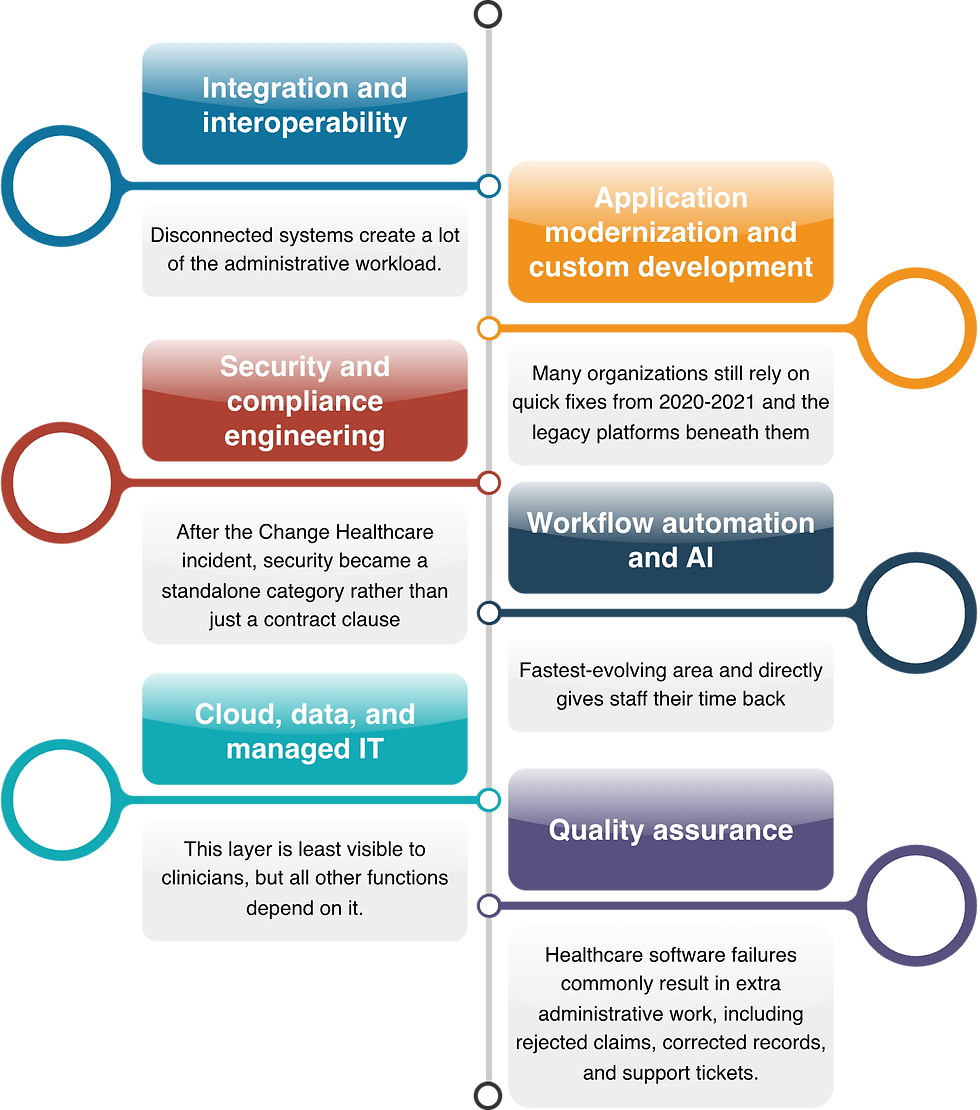
Today's IT outsourcing spans six areas, each addressing a specific part of the administrative burden.
Integration and interoperability
Disconnected systems create much of the administrative workload. When EHRs, practice management systems, payer portals, and patient apps do not share data, staff must re-enter information manually. Typical outsourced work includes:
EHR integrations
FHIR APIs and HL7 interfaces
Payer connectivity for eligibility, claim status, and prior authorization
Data exchange with labs, pharmacies, and registries
In Europe, preparing systems for the exchange formats and EHR requirements of the European Health Data Space, which applies from March 2027
Workflow automation and AI
This is the fastest-evolving area and directly gives staff their time back. Typical outsourced tasks include:
Automated eligibility and claim-status checks
Rules-based routing of referrals, documents, and inbox messages
Integration of ambient documentation tools into clinical workflows
Agentic multi-step administrative tasks under human supervision
The points above require AI governance, monitoring, audit trails, accuracy testing, and escalation procedures for human review.
Application modernization and custom development
Many organizations still rely on quick fixes from 2020-2021 and the legacy platforms beneath them. Typical outsourced tasks include:
Re-platforming or refactoring legacy applications
Consolidating overlapping tools
Rebuilding internal tools around the people who use them
Building patient apps, clinician tools, remote monitoring and digital health products, especially for health-tech companies that outsource most of their engineering
Security and compliance engineering
After the Change Healthcare incident, security became a standalone category rather than just a contract clause, which now typically covers
Security operations and vulnerability management
Zero-trust architecture implementation
Pentesting and HIPAA risk analysis
Software supply-chain security, including SCA and SBOMs
Engineering for HIPAA, SOC2, GDPR, and EHDS
Quality assurance
Healthcare software failures commonly result in extra administrative work, including rejected claims, corrected records, and support tickets. So typical outsourced tasks in this area include, but are not limited to:
QA test automation
Performance/load/stress testing
Integration testing across EHR
Cloud, data, and managed IT
This layer is least visible to clinicians, but all other functions depend on it. Typical outsourced tasks include:
Cloud migration
Big Data platforms and analytics
Managed infrastructure and monitoring
Clinician-facing service desks
At a glance
Area | Typical outsourced work | Admin tax it targets |
|---|---|---|
EHR integrations, FHIR/HL7, payer connectivity, EHDS readiness | Duplicate entry, swivel-chair work | |
Automated checks, routing, ambient documentation, agentic AI, AI governance | Repetitive rules-based tasks | |
Re-platforming, tool consolidation, new apps and platforms | Workarounds in legacy tools | |
SecOps, pen testing, zero trust, SBOMs, regulatory engineering | Manual fallback after incidents, compliance overhead | |
Test automation, integration and validation testing | Rework from defects | |
Cloud ops, data platforms, monitoring, service desk | Foundation for automation |
What stays in-house
Even with a strong partner, some responsibilities must remain within the organization:
Architecture decisions and technology strategy
Data governance and ownership
Clinical safety sign-off for anything that touches care
Accountability for vendor risk
Vendor risk, compliance and AI governance
Every outsourced process and automated workflow, while solving one problem, may create another. When work is being delegated to a partner, they get access granted to your systems and data. Similar happens when using AI agents; one must know what actions they took, why, and who is accountable for any errors.
Since 2024, these concerns have moved from procurement checklists to service contracts. Here we address three areas: vendor risk, regulatory requirements, and the emerging discipline of AI governance.
Vendor risk: lessons from the last three years
The case for taking third-party risk seriously predates 2024. Сybersecurity official reported that more than half of the 707 health data breaches in 2022 involved third-party service providers. Security leaders interviewed at the time also raised a related problem: some vendors were unwilling to sign business associate agreements or accept meaningful liability for the health data they processed.
A mature vendor risk program covers the full life of a partnership.
Before signing
A signed BAA before any access to protected health information
Independent evidence of security controls
A clear map of where data will be stored and processed, and by whom, including subcontractors
A review of the partner’s own third-party dependencies
In the contract
Breach notification timelines and incident resolution obligations
Cyber insurance requirements
Audit rights
Clear rules for data return and destruction when the contract ends
During the partnership
Least-privilege access, with MFA everywhere and access reviewed regularly
Continuous assessment of the partner’s security posture, not a one-time questionnaire
Joint incident response exercises
At the exit
A tested plan for continuing operations if the partner becomes unavailable
Documented knowledge transfer, so critical systems aren’t understood only by the vendor.
Compliance: what’s in force, and what’s coming
In the US, the current HIPAA Security Rule remains fully in force and enforceable. OCR continues to enforce it actively.
The proposed overhaul, published in January 2025, is raising the bar considerably. It requires written documentation for all security policies and analyses, and converts several safeguards that are currently “addressable” into required controls. Final action has been pushed back to July 2027 at the earliest.
We recommend emphasizing asset inventories, encryption coverage, and MFA, and building them now regardless of when the rule is enforced.
In the EU, the regulatory picture is broadening:
GDPR continues to govern health data as a special category of personal data.
The EHDS Regulation entered into force in March 2025 and applies from March 26, 2027. It sets requirements for EHR systems and for how health data is accessed and exchanged. Cross-border exchange of the first priority categories, patient summaries and ePrescriptions, follows in March 2029.
The EU AI Act applies to any AI system placed on the EU market. It sorts systems into four risk categories, from minimal to unacceptable, with obligations that scale accordingly.
For software as a medical device, MDR in Europe and FDA requirements in the U.S. add design controls, risk management, and cybersecurity expectations. Standards such as AAMI SW96 describe how to perform security risk management for device software.
As compliance cannot be added after delivery, partners building or operating healthcare software must show how they integrate compliance into their processes. This includes:
Security requirements defined at design time
Threat modeling and risk analysis
Technical and operational documentation produced alongside the implementation
Test plans and coverage matrices that verify regulatory controls
AI governance: the new layer
Automation and AI are the main reason administrative work can finally shrink. They also introduce risks traditional vendor management wasn’t designed for:
Errors at scale. A human coder makes occasional mistakes. A misconfigured model can make the same mistake across thousands of claims before anyone notices.
Hallucination and bias. Generative models may produce inaccurate/unreliable outputs quite often, especially if trained on unbalanced training data. Deloitte flags both as reasons for caution in healthcare.
Autonomy without accountability. Agentic AI acts rather than suggests. Absent clear limits, it is hard to say who approved a decision and why.
Data leaving your control. Prompts and documents sent to external model providers may contain PHI, which brings that provider into scope for HIPAA and GDPR.
Overpromised projects. Gartner has warned that more than 40% of agentic AI projects may fail by 2027 because expectations outran reality.
Good AI governance applies the same discipline as vendor risk management, extended to systems that make decisions:
Control | What it means in practice |
|---|---|
Human-in-the-loop thresholds | Define which actions an agent can take alone, which need review, and which it should never take |
Full audit trails | Log every input, output and action so any decision can be reconstructed |
Data minimization | Send models only the data a task requires; de-identify where possible |
Model provider agreements | Treat AI vendors as business associates: BAAs, data residency and no training on your data |
Evaluation before go-live | Test accuracy on your own data and edge cases, not just vendor benchmarks |
Ongoing monitoring | Track error rates, drift and exceptions after launch, with clear owners |
Kill switch and rollback | Be able to pause automation and fall back to manual processes without disruption |
Named accountability | Every automated workflow has an internal owner responsible for its outcomes |
The goal is not to slow AI adoption, but to ensure efficiency gains don't introduce unmanaged risks.
Questions to ask any healthcare IT partner
Will you sign a BAA, and which subcontractors will access our data?
Where will our data be stored and processed, including by AI model providers?
How do you enforce MFA and least-privilege access for your own staff?
How do you build HIPAA, GDPR, and EHDS requirements into design and testing?
What does your incident response plan look like, and when did you last run it?
For AI features: what can the system do without human approval, and how is every action logged?
If you became unavailable tomorrow, how would we keep operating?
A partner that can respond to these clearly is managing risk. A partner that answers with promises is shifting the risk to you.
Engagement models and real costs
If the goal is to eliminate administrative work rather than relocate it, the commercial model is as important as the technology. Paying for hours yields hours; paying for unmeasured outcomes leads to disputes. This section reviews how engagement models match project stages, the true costs of healthcare software, and why the lowest initial price is rarely the most cost-effective long term.
Model | How it works | Best for | Watch out for |
|---|---|---|---|
Fixed-scope project | Agreed deliverables, timeline and price | Well-defined work: a specific integration, a discovery phase, a security assessment | Rigid when requirements change; risk is often priced into the quote |
Time and materials | Pay for actual effort, scope evolves | Work where the solution emerges as you learn, such as workflow automation | Needs active management and clear priorities to stay on budget |
Staff augmentation | Individual engineers join your team under your management | Filling specific skill gaps when you have strong internal technical leadership | You carry delivery management and quality risk |
Dedicated team | A stable, cross-functional team works only on your product or program | Ongoing development, modernization and multi-workflow automation programs | Needs a long-term roadmap to justify the commitment |
Managed services | Partner runs and supports systems against service levels | Operating integrations, infrastructure, monitoring and support after go-live | Service levels must measure what matters, not just uptime |
Outcome-based | Fees tied partly to measured results, such as hours saved or denial rates | Workflows with clean baselines and metrics both sides trust | Requires reliable measurement and a fair split of what each side controls |
Build-operate-transfer | Partner builds and runs a capability, then hands it to you | Organizations that want to own capability in-house long-term | Transfer terms must be defined up front |
The industry is shifting toward results-based models. HFS reports that leading service providers now offer quantified clinical and financial results rather than IT productivity. However, outcome-based pricing requires a baseline, making a measured pilot essential.
A worked example: comparing the options over three years
Scenario: A provider group performs 8,000 manual insurance eligibility checks a month at about six minutes each. That’s 800 hours a month, or 9,600 hours a year.
The cost assumptions:
In-house staff cost $35/hour.
An offshore partner costs $12/hour, including vendor management.
Automation costs $150,000 to build and integrate, plus $30,000 a year to run.
Automation handles 80% of checks; the rest still need a person.
Option | Year 1 | Annual cost after year 1 | 3-year total |
|---|---|---|---|
A. Keep in-house | $336,000 | $336,000 | $1,008,000 |
B. Outsource to offshore team | $115,200 | $115,200 | $345,600 |
C. Automate. Keep remaining 20% in-house | $247,200 | $97,200 | $441,600 |
D. Automate. Keep remaining 20% offshore | $203,040 | $53,040 | $309,120 |
Explanation:
Offshore outsourcing is the cheapest option in year one. If your horizon is twelve months, option B wins.
The hybrid overtakes it after about 2.5 years. Option D costs $150,000 more upfront but about $62,000 less each year.
Volume growth widens the gap. If check volumes grow, option B’s cost grows with them. Option D’s cost barely moves, because automation’s marginal cost is close to zero.
Automation alone isn’t the answer either. Option C keeps the remaining 20% in-house at full cost and ends up more expensive than B. The best result comes from engineering the predictable core and using people for the variable edges.
Cost is not the only consideration. Options B and D both reduce internal workload, but only automation delivers cleaner data, faster turnaround, and a system your organization owns.
How to compare proposals
Use the same horizon for every option: at least three years for anything involving software.
Model volume growth, not just today’s numbers.
Count all costs, including internal time, transition, and governance.
Value the outcomes: hours returned to staff and clinicians, reduced errors and denials, and faster turnaround.
Check what you own at the end: a contract, or an asset you can keep improving.
The lowest initial quote rarely results in the lowest total cost, and the cheapest option in year one is seldom the most cost-effective by year three.
Benefits of healthcare IT outsourcing
Outsourcing engineering, rather than just administrative tasks, changes the value delivered:
Better patient care. Eliminating duplicate data entry, manual checks, and inbox clutter gives clinicians time back. Deloitte estimates this can save 240-400 hours per nurse annually. Cleaner, connected data also cuts errors and shortens patient wait times.
New services and revenue streams. Virtual care, remote monitoring, and digital products enable providers to reach new patients and locations. Health-tech companies can scale without first building a full engineering organization.
Reduced long-term costs and higher quality. Automation involves primarily upfront costs and minimal per-transaction expenses, resulting in increasing savings over time. Automated processes also operate consistently and make errors easier to spot.
Specialist expertise on demand. Access integration engineers, security architects, AI specialists, and regulatory experts as an extended team, managed service, or complete product.
Flexible scaling. Adjust engineering capacity to meet deadlines, launch new service lines, or support modernization programs. Well-designed automation absorbs volume growth with minimal additional cost.
Faster delivery. Partners with relevant experience accelerate discovery and help avoid common mistakes. Each integration completed streamlines future projects.
Stronger security, with the right partner. Specialist partners provide monitoring, testing, supply-chain controls, and incident response capabilities that are difficult to develop internally. However, a vendor can become a single point of failure, so verify its security measures first.
How can Plexteq help you achieve your business goals with healthcare-related IT outsourcing?
Since 2014, Plexteq has built software for healthcare organizations, delivering over 30 solutions for hospitals, clinics, assisted living facilities, and health-tech companies. Our approach matches the one described in this article: eliminate administrative work instead of just moving it, build security and compliance in from the start, and ensure clients keep ownership of the results.
We build solutions that reduce administrative work. Our teams deliver integrations, automation, and AI to speed up operations, such as EHR and payer integrations, workflow automation, data platforms, anomaly detection, and AI features with human oversight. We begin by mapping your current workflow, then decide what to automate, redesign, or keep manual.
Security and compliance are central to how we work. We design for HIPAA, GDPR, and EHDS requirements from the start, with specialized expertise in medical device security risk management.
We update and stabilize existing systems. Not every problem needs a brand new solution. Our application modernization and App Repair Lab teams improve, re-platform, and enhance current healthcare software.
We build quality into every step of our process, not just check it at the end. Our dedicated software testing, test automation, performance testing, and audit services catch problems before they create extra work for clinicians and billing staff.
We offer engagement models for each project stage, including fixed-scope discovery, dedicated teams, managed services, and CTO-as-a-service. Start with a measured pilot and scale up as you see results.
You can count on our delivery. With offices in Estonia, the UK, and Ukraine, we offer an EU base and experienced engineering teams.
You own everything we build. Code, configurations, documentation, and data all stay with you, so you keep the efficiency gains.
Start with one workflow
Tell us which administrative workflow takes up the most time for your team. We’ll help you map it, measure your starting point, and design a 90-day pilot to show what you can remove.

FAQ
What is healthcare IT outsourcing?
Healthcare IT outsourcing involves partnering with an external technology provider to build, integrate, secure, or operate healthcare software and systems. This can range from augmenting your team to delivering complete products or managed services. Unlike healthcare BPO, IT outsourcing focuses on changing systems rather than staffing administrative tasks.
What is the difference between healthcare BPO and healthcare IT outsourcing?
BPO transfers administrative tasks to an external team. In contrast, IT outsourcing modifies systems to reduce or eliminate work, such as automating eligibility checks instead of assigning staff. Most organizations use both approaches.
Which healthcare IT functions are most commonly outsourced?
Commonly outsourced functions include EHR and payer integrations, workflow automation and AI, application modernization, security and compliance engineering, quality assurance and testing, as well as cloud, data, and managed IT services.
How can IT outsourcing reduce clinicians' administrative burden?
IT outsourcing reduces administrative burden by addressing root causes such as duplicate data entry, manual checks, disconnected systems, and inbox overload. Physicians currently spend nearly half their office day on EHR and desk work. Integration and automation directly reduce this time.
Is outsourcing healthcare software development HIPAA compliant?
Yes, it can be HIPAA compliant. Your partner must sign a business associate agreement, demonstrate security controls such as SOC 2 Type II or ISO 27001, and incorporate HIPAA requirements into development. Your organization remains responsible for compliance.
How much does healthcare software development cost?
Costs depend primarily on integration complexity, compliance requirements, AI governance, and long-term operations, rather than just hourly rates. Evaluate options over at least three years, considering hidden costs such as transition and vendor management.
Which engagement model is best for healthcare IT projects?
The best engagement model depends on the project stage:
Discovery: fixed-scope
Building automation: time-and-materials or dedicated team
Running systems: managed services
Proven workflows: outcome-based pricing
How do we choose the right healthcare IT outsourcing partner?
Seek partners with experience in your specific workflow, verified security practices, transparency regarding AI, and clear ownership of code and data. Be cautious of fixed-price quotes provided before a thorough workflow assessment.
How should we start an outsourcing engagement?
Begin with a 90-day pilot on a high-volume, rules-based workflow. Measure the baseline, redesign and automate the process, pilot on a limited scope, and compare results before scaling.
How will AI change healthcare IT outsourcing by 2030?
Agentic AI will automate administrative tasks that are currently outsourced to people, such as coding and claims follow-up. Expect an increase in outcome-based contracts, stronger AI governance, and more organizations owning their automation instead of renting it.
External references
Allocation of Physician Time in Ambulatory Practice: A Time and Motion Study in 4 Specialties, https://pubmed.ncbi.nlm.nih.gov/27595430/
2026 Global Health Care Outlook, https://www.deloitte.com/us/en/insights/industry/health-care/life-sciences-and-health-care-industry-outlooks/2026-global-health-care-outlook.html


