Beyond Legacy: How Insurers Are Modernizing Core Systems to Compete and Scale

The insurance industry stands at a pivotal crossroads. Legacy core systems - built for a different era of business - are increasingly unable to meet the speed, flexibility, and digital expectations that today's market demands. From billing and underwriting to claims processing and customer-facing services, outdated infrastructure creates technical debt, limits innovation, and puts insurers at a growing competitive disadvantage.

Core systems modernization is no longer a long-term ambition - it is an operational imperative. Insurers that modernize their foundational technology gain the ability to automate complex workflows, integrate data across the business, accelerate product development, and deliver the seamless digital experiences customers now expect as standard.
Yet modernization is not a one-size-fits-all endeavor. The path an insurer takes must reflect its size, operational scope, strategic goals, and tolerance for transformation risk. Whether through a centralized, federal, or hybrid approach, the decisions made at the outset will shape an organization's scalability and competitiveness for years to come.
This article examines how insurance companies can navigate the core modernization journey with clarity and confidence. It covers:
The strategic frameworks available to insurers - centralized, federal, and hybrid - each suited to different organizational needs and goals.
The key factors that guide strategy selection, including company size, operational scope, budget, and long-term growth objectives.
Seven best practices for successful IT transformation, from aligning IT with business goals and prioritizing customer-centric solutions, to leveraging agile methodologies and measuring progress through KPIs.
Together, these insights provide a practical foundation for insurance organizations ready to move beyond legacy constraints and build the scalable, future-ready systems their business demands.
The optimal core modernization strategy may help insurance enterprises to:
Selecting the right approach to core IT modernization is a pivotal decision for any insurance company navigating its transformation journey. A well-chosen strategy serves as the foundation for efficient operations, scalable solutions, and lasting competitiveness in an industry increasingly shaped by technological innovation. The modernization path empowers insurers to:
Leverage AI and machine learning to capture richer data and streamline the claims process
Limit adverse selection through smarter, data-driven risk assessment
Process claims settlements faster and with decreased risk
Reduce the cost of onboarding and processing new clients
Build new platforms that deliver stronger, more measurable business value
Increase customer satisfaction through virtual assessments and digital-first interactions
Develop new products with digital tools that meet evolving customer expectations
Enhance IT operational performance and unlock greater team productivity

Driving Efficiency with the Right Strategy
Tailored core IT modernization enables insurers to streamline legacy systems, automate routine processes, and cut IT maintenance costs. Modernizing core platforms - such as claims management - directly reduces processing times and improves operational throughput.
Scalability to Meet Future Demands
A well-chosen modernization strategy equips insurers with architecture that scales as business needs evolve. Cloud-based infrastructure, for example, allows dynamic resource allocation - supporting growing customer bases and regulatory shifts without requiring full system overhauls.
Staying Competitive in a Rapidly Evolving Market
Insurers that delay modernization risk losing ground to more agile competitors. A robust IT transformation strategy enables data-driven underwriting, advanced risk analytics, and personalized customer experiences - capabilities that are increasingly table stakes in the modern insurance market.
Core IT modernization is a business imperative. For insurers, the ability to balance efficiency, scalability, and competitiveness will define their position in an increasingly digital landscape.
Core IT Modernization: Three Strategies Unpacked
The right core IT modernization strategy determines how efficiently an insurer can operate, scale, and compete. Three proven approaches - centralized, federal, and hybrid - offer different levels of control, flexibility, and investment, making strategy selection a critical first step for any insurance organization.
IT Modernization Strategy | Description | Ideal For | Key Advantages | Considerations |
|---|---|---|---|---|
Centralized | Consolidates all IT functions under a single authority. | Smaller organizations. |
| Requires strong governance to align top-down decisions with operational needs. |
Federal | Balances centralized oversight with decentralized execution, allowing autonomy for business units or regions. | Medium to large insurers with diverse products or geographic footprints. |
| May require careful coordination to maintain balance between autonomy and oversight. |
Hybrid | Combines elements of centralized and federal models, offering flexibility to customize based on needs. | Organizations undergoing IT transformation. |
| Requires strategic planning to ensure the right balance of centralization and decentralization. |
A centralized IT strategy consolidates all IT functions under a single authority. This approach is ideal for smaller organizations seeking consistent standards, simplified management, and cost efficiencies. However, it requires strong governance to ensure top-down decisions align with operational needs.
The federal IT strategy balances centralized oversight with decentralized execution. Individual business units or regional branches maintain autonomy while adhering to shared frameworks. This strategy works well for medium to large insurers with diverse product offerings or geographic footprints, as it combines local responsiveness with organizational alignment.
The hybrid IT strategy blends elements of both centralized and federal models, offering flexibility to customize based on specific needs. For instance, an insurer may centralize infrastructure oversight while allowing individual teams to manage customer-facing applications. This approach is often favored by organizations undergoing IT transformation as it provides a tailored, scalable solution.
The right choice depends on the insurer's size, structure, and strategic priorities. A well-aligned modernization strategy optimizes resources today while building the foundation for long-term innovation and growth.
Centralized Core IT Modernization: When Uniformity is Key
A centralized strategy consolidates all IT functions into a single, unified system - making it the go-to model for insurers that prioritize operational consistency, cost control, and governance.
Key Advantages
Uniform systems reduce redundancies and enable consistent, company-wide policy implementation
Economies of scale lower costs through bulk licensing and streamlined vendor management
Single-point governance simplifies security, compliance, and enterprise-level risk management
Straightforward regulatory oversight across the organization
When to Choose This Strategy
A centralized approach is best suited for smaller insurers, companies with a limited product portfolio, or those operating in heavily regulated markets. It is also an effective starting point for organizations embarking on broader digital transformation - establishing a cohesive IT foundation before scaling or diversifying operations.

For insurers who value consistency, cost control, and streamlined governance, centralized IT modernization offers a proven path forward. By unifying systems under one roof, organizations can enhance efficiency and lay a stable groundwork for both current operations and future innovation.
Federal Core IT Modernization: Balancing Autonomy and Control
The federal IT strategy offers a balanced approach to modernization, combining regional autonomy with group-level oversight to meet the diverse needs of modern insurance organizations. This model is particularly well-suited for insurers operating across multiple regions, with varying customer demands and regulatory environments, as it ensures flexibility alongside unified governance.
Key Features
Regional branches operate their own IT systems within centrally defined frameworks and standards
Localized teams can adopt market-specific tools - such as regional underwriting applications - while remaining aligned with group-wide security and compliance protocols
Central oversight ensures data integration, resource efficiency, and organizational coherence across all units
When to Choose This Strategy
The federal model is best suited for medium to large insurers with geographically dispersed operations or diverse product portfolios:
Global insurers managing international and local products simultaneously
Multi-line insurers — life, property, health — requiring IT flexibility across distinct business lines
Operators in regulatory-heavy markets where compliance requirements vary significantly by region or jurisdiction
By combining regional agility with centralized governance, the federal strategy enables insurers to innovate at the local level while maintaining the stability and consistency required at scale.

The federal core IT modernization strategy represents an ideal blend of flexibility and control. It empowers insurers to meet localized demands without sacrificing enterprise-wide consistency. By aligning regional autonomy with group-level governance, this approach enables organizations to drive innovation, reduce inefficiencies, and maintain robust insurance IT governance across their operations. For insurance companies navigating complex structures and markets, the federal strategy offers a path to scalable, sustainable modernization.
Hybrid Core IT Modernization: Flexibility Meets Control
The hybrid strategy combines the strengths of centralized and federal models - delivering the structural consistency and governance of a centralized approach alongside the market responsiveness and adaptability of a federal one. For insurers operating in complex, multi-market environments, this balance makes the hybrid model one of the most versatile modernization paths available.
How It Works
At its core, the hybrid approach draws a clear line between what should be governed centrally and what should be managed locally. Critical functions - data storage, security protocols, compliance frameworks, and enterprise-wide technology investments - are consolidated at the group level to ensure consistency, integration, and regulatory alignment across the organization. At the same time, regional and departmental teams retain meaningful autonomy over localized systems and customer-facing tools, such as mobile applications, policy management platforms, or market-specific underwriting solutions.
This division of responsibility is governed by a structured decision-making framework that defines boundaries between group-level oversight and regional control — preventing duplication, reducing inefficiencies, and enabling faster response to local market shifts.
When to Choose This Strategy
The hybrid model is particularly well-suited for large, complex insurance organizations with diverse operational footprints:
Multinational insurers navigating varied regulatory environments across multiple markets
Multi-line insurers managing distinct product portfolios — such as life, property, and health — that require both standardization and localized flexibility
High-growth insurers looking to scale operations without sacrificing the agility needed to compete in dynamic markets

By intelligently distributing decision-making across group and regional levels, the hybrid strategy empowers insurers to foster ground-level innovation while maintaining the enterprise-wide control and governance required for sustainable, long-term growth.
Best Practices for Core IT Modernization in Insurance
Achieving success in insurance core IT modernization requires a strategic approach grounded in proven principles. The following seven best practices provide a comprehensive roadmap for insurance companies to modernize their IT infrastructure effectively, regardless of their chosen strategy.
# | Step | Details | Benefits |
|---|---|---|---|
1 | Align IT and Business Goals | Align IT priorities with organizational goals like operational efficiency, customer satisfaction, or profitability to ensure modernization delivers tangible business value and supports long-term growth. |
|
2 | Prioritize Customer-Centric Solutions | Focus on building systems that improve customer experiences, such as streamlined claims processing or personalized policy management platforms, to strengthen competitiveness in the insurance market. |
|
3 | Define a Scalable and Modular Tech Stack | Design scalable, modular systems for easy updates and integration of new technologies, ensuring flexibility to adapt to market trends and regulatory changes while enabling cost-effective growth. |
|
4 | Leverage Agile Methodologies | Use agile methodologies to enable quicker, iterative transformations, allowing for efficient testing, refinement, and deployment of solutions while catching potential issues early. |
|
5 | Ensure Robust Risk Management | Develop risk management frameworks to identify and mitigate risks like operational disruptions or cybersecurity threats, and create contingency plans to ensure business continuity during challenges. |
|
6 | Foster Collaboration Between Teams | Promote collaboration between regional and group-level teams to align localized needs with group-wide objectives, maintaining consistency while addressing regional requirements. |
|
7 | Measure Success Through Clear KPIs | Define KPIs like system uptime, customer satisfaction, or time-to-market for new products to track progress and ensure alignment with business goals. |
|
By following these IT modernization best practices, insurance companies can streamline the transformation process, minimize risks, and maximize outcomes. From strategic alignment to fostering collaboration, each of these principles contributes to building a robust, flexible, and future-ready IT infrastructure. With a well-executed core modernization effort, insurers can meet today’s demands while preparing for tomorrow’s opportunities.
How to Select the Right Core IT Modernization Strategy
Choosing the right core IT modernization strategy is one of the most consequential decisions in an insurer's transformation journey. The right choice must reflect your organization's specific structure, operational scope, and resource capacity - ensuring that every technology investment translates into measurable gains in efficiency, scalability, and competitive positioning.
Three factors are central to making an informed decision: company size and organizational structure, the breadth of your operations, and the resources available to execute and sustain the transformation.
1. Assess Company Size and Structure
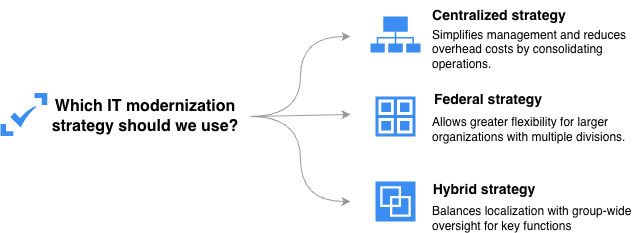
Organizational size and complexity are the first indicators of which strategy will work best. Smaller insurers with straightforward structures are well-suited to a centralized model - it reduces overhead, simplifies management, and consolidates operations into a single governed framework. Larger organizations with multiple divisions or product lines require the flexibility of a federal or hybrid approach, which accommodates operational complexity without compromising enterprise-wide governance.
2. Evaluate Operational Scope: Regional vs. Global
The geographic footprint of your business directly shapes your modernization options. A centralized strategy ensures consistency across operations but may limit the ability to respond to local market conditions. A federal strategy is the stronger fit for geographically dispersed insurers, giving regional branches the autonomy to adapt IT systems to local needs while remaining aligned with corporate standards. A hybrid approach offers a middle ground - enabling localization where it matters while maintaining central oversight over critical functions such as compliance and data management.
3. Analyze Budget and Resource Availability
Financial capacity is a practical constraint that must inform strategy selection. Centralized strategies are typically more cost-effective upfront, eliminating redundancies and consolidating infrastructure costs. Federal and hybrid models require greater investment in customization and localized infrastructure, but offer stronger long-term returns for complex organizations.
When evaluating options, weigh short-term financial outlay against long-term ROI - ensuring the chosen strategy is sustainable beyond the initial transformation phase.
# | Step | Details | Benefits |
1 | Assess Your Company’s Size and Structure | Evaluate the size and complexity of your organization to determine the best IT strategy. |
|
2 | Evaluate Regional vs. Global Operations | Consider the geographic scope of your operations. |
|
3 | Analyze Budget and Resource Availability | Assess budget constraints and resource allocation. |
|
Selecting the best modernization strategy is a tailored process that requires careful consideration of your company’s objectives and capabilities. Whether you’re focusing on insurance modernization planning for a small, centralized business or navigating the complexities of a global insurer, aligning your choice with these critical factors ensures a successful and impactful IT strategy selection.
Conclusion: Choosing the Right Core IT Modernization Strategy
Centralized, federal, and hybrid strategies each offer a distinct path to modernization - and the right choice depends entirely on your organization's size, structure, operational scope, and long-term objectives. There is no universal answer, but there is a right fit for every insurer.
Strategy | Description | Ideal For |
|---|---|---|
Centralized | Consolidates all IT functions under one authority to simplify management, reduce redundancies, and ensure consistency across operations. | Smaller insurers or those with limited scale and straightforward operations. |
Federal | Balances autonomy and oversight by allowing localized IT management while adhering to group-wide standards. | Medium to large insurers with regional or global operations needing flexibility and alignment. |
Hybrid | Combines centralized governance for critical functions with localized adaptability to meet specific requirements. | Large, multi-faceted organizations undergoing complex IT transformations. |
Align Strategy with Organizational Goals
Effective core IT modernization is not just a technology decision - it is a business one. The strategy you choose must support your organization's priorities, whether that means driving cost efficiency, enabling operational flexibility, or building the scalable infrastructure needed for future growth. Misalignment between IT strategy and business goals is one of the most common - and costly - pitfalls in transformation programs.
Start Your Modernization Journey
The first step is clarity: a precise understanding of where your organization stands today and where it needs to go. From there, a well-structured modernization roadmap can turn strategic intent into measurable outcomes - positioning your company for sustained growth, innovation, and competitiveness in an increasingly digital insurance market.
Ready to define your modernization strategy? Get in touch with our team today.